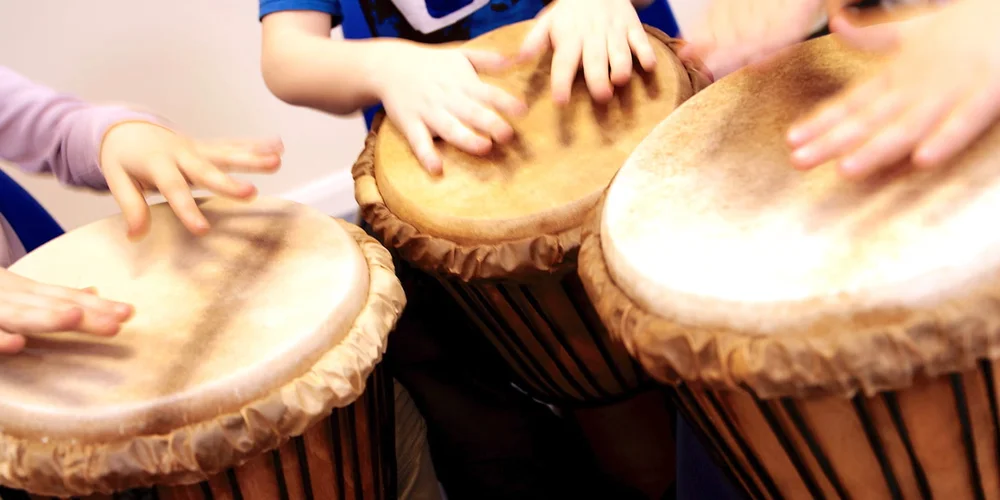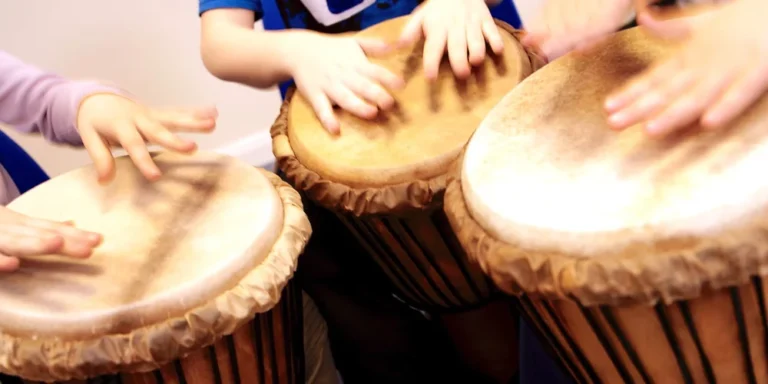
Primary hands above djembe – If you’re asking what size djembe drum do I need, it’s very important to get the djembe size right – if it’s too small, you or your class won’t be able to do proper two-handed drumming and produce the three basic sounds: bass, tone and slap.
On the other hand, drums that are too big will quickly eat up your budget, and they can be heavy for younger players as well as taking up more storage space.
So how do you decide what size of djembe drum to buy for yourself or your class? This djembe drum sizes guide starts with the basics.
There are two dimensions that specify a djembe’s size: the diameter (usually quoted in inches) and the height (usually quoted in centimetres). The diameter is the most important measurement as, if this is too small, it will be very difficult to play the three different djembe tones.
Make sure the djembe diameter is right for the players’ hand sizes
Depending on the age group of your class, we’d recommend buying drums which have at least the minimum diameters in the table below. Ideally (budget permitting) go for drums that are one or two centimetres bigger than these recommended minima — especially for djembe drum for beginners, where comfort helps good technique.
Please note, there are two types of diameter: the “playing head diameter” (which is the diameter of the area inside the metal rings and stringing), and the “overall diameter”, which is the easiest to measure, and is the maximum diameter from one side of the head to the other. In other words, when you’re checking the diameter of a djembe drum, make sure you know which measurement is being used. On most djembes the playing head diameter is generally about an inch less than the overall diameter. The diameters of the djembes on our website are all quoted in terms of overall diameter.
Click on the table to see a bigger version.

What size djembe drum do I need? The measurements in the table are for guidance and are taken from readily available online research. You may find that your class has bigger or smaller hands – and on average girls will tend to have slightly shorter hands than boys.
Click here to download a printable version of the table with QR codes
Can I mix different sizes of djembe in the same group or class?
It’s fine to have all drums the same size, but it also works well to have a mix of drum sizes in a class. If you go for a mix of sizes, don’t overdo the bigger ones – a good rule of thumb is that half the drums should be around the minimum size for the age group, a third should be a couple of centimetres bigger, and the rest four or five centimetres bigger than the minimum. This will give a nice, full sound and allow you to differentiate the different parts in most djembe drumming pieces. Having a few bigger drums will also allow you to cater for pupils who are much bigger than average — useful when choosing djembe drums for schools and whole-class sets.
What about djembe height?
As for djembe height, that tends to be less important than the diameter, unless you intend to play with the drum resting on the floor (and tilted slightly to let the sound out). We’d recommend holding the djembe between the legs and off the floor – this makes the djembe height much less important and also makes for more comfortable playing and produces a better sound.
Djembe stands
There are specially made djembe stands available for players who are unable to grip the djembe between their legs. These stands are also very useful for class teachers, as they allow the teacher’s drum to be played, whether or not the teacher is seated.
Frequently Asked Questions
What size djembe drum should I get?
Start with djembe drum sizes based on the players’ hand size and age group. In practice, the djembe diameter matters most for clear bass, tone and slap, so follow your minimum diameter guide and, if budget allows, go a little bigger for comfort. For classes, a mixed set works well: keep most drums near the minimum, then add a smaller number of larger ones for fuller sound and bigger pupils.
What is the 80/20 rule in drumming?
It’s a simple practice rule: spend 80% of your time on core skills (steady pulse, timing, clean technique), then 20% on extras (fills, breaks, speed). On djembe, that usually means locking the beat and refining the three sounds—bass, tone and slap—before you add more complex patterns.
How do I know my drum size?
Measure two things: overall diameter (widest point across the head) and djembe height (top to base). Also note the playing head diameter is the playable area inside the rings and rope, and it’s often about an inch smaller than the overall diameter. Use the diameter number first when you’re matching drums to hand size.
What size drum kit should I buy?
Choose based on player age, space and volume needs. A compact kit helps beginners reach everything comfortably and keeps noise manageable, while larger kits suit older players who need more range. If your goal is group hand drumming rather than a full kit setup, a djembe drum for beginners or class set plus a djembe stand for teachers can be the simpler option.